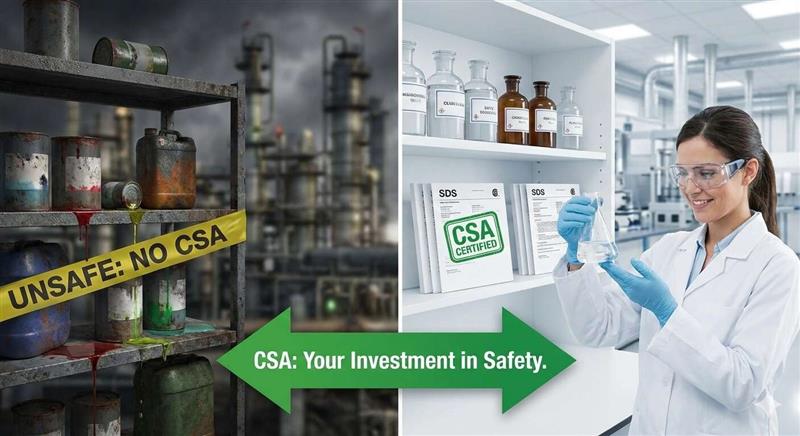
Beyond the Label: Why Chemical Safety Assessment is Your Career's Smartest Investment
We’re all hit with thousands of chemicals every day, from the food we eat, the water we drink, and even the products we use to live our lives. But who ensures that that brand new industrial-strength solvent or cleaning product won’t kill us or the environment?
The answer lies in a thorough scientific analysis known as Chemical Safety Assessment (CSA).
If you work in the chemical industry, you've probably heard of it. But to many people, it's shrouded in mystery. Today, we’re going to take a peek behind the curtain of the CSA process and discover why getting certified as a CSA expert is the best career move you can make for yourself.
So what is a Chemical Safety Assessment?
In simple terms, a Chemical Safety Assessment is an evaluation of how hazardous a chemical is to humans and how it will affect all aspects of human life.
A CSA answers questions such as: "Is this a toxic substance?" "Will it cause long-term adverse effects to humans?" "How much exposure is safe for a factory worker?"
The goal of a CSA is not just to identify hazards but to ensure that the chemical can be used safely.
The Stakes Have Never Been Higher: Why CSA Expertise is On Fire Right Now
So why are experts in CSA popping up left and right all over the place today?
Well, here's a hint of what’s going on behind the scenes:
-
There are increasing amounts of regulations like EU-REACH, UK-REACH, Turkey-KKDIK, and Korea-REACH that require CSA for the registration of every chemical.
-
A CSA is classified under the realm of “ethics” and “responsibility,” because without CSA present, entire populations are at risk of being harmed or killed by toxic substances.
-
Companies can avoid damaging headlines and lawsuits about products causing harm to people if CSA is completed early in the process.
-
Product developers can ensure that they create safe products that align with all current sustainability trends.
-
A failure in CSA leads to bans, lawsuits, and irreparable damage done to companies’ brands.
Breakdown of the CSA Process
To understand what a CSA entails, it's important to go through each step of the CSA analysis of a chemical:
Step 1: Hazard Identification: Collection of all relevant physical data on the chemical, such as toxicity or environmental hazards.
Step 2: Hazard Assessment: Evaluation of “dose-response” for all hazards. For each hazard, the scientist calculates a safe exposure limit (e.g., DNEL for humans, PNEC for non-humans).
Step 3: Exposure Assessment: This second step in the CSA looks at who will be exposed to this chemical in all aspects of its lifecycle. This can include factory workers using the chemical, as well as children playing with it.
Step 4: Risk Characterization: This combines the hazard data from Step 1 with exposure data from Step 3. The CSA expert will assess whether or not people will be able to avoid harmful levels of exposure.
Step 5: Reporting: Finally, the CSA expert compiles a Chemical Safety Report (CSR) that guides not only the development of SDSs (Safety Data Sheets), but also ensures safe exposure scenarios along the entire supply chain.
Meet the Chemical Safety Professionals
So who are these CSA experts that are keeping our safety and health on the right track?
The people who keep us safe from toxic substances come from all walks of life with one thing in common: they care about people.
They can be:
-
Regulatory Affairs Managers who keep companies compliant with regulations like EU-REACH.
-
Toxicologists who identify the hazards in substances and provide safe exposure levels.
-
Environmental Scientists who ensure that companies do not harm the environment.
-
Consumer Safety Specialists who ensure that consumer products are safe to use.
-
Product Safety Managers who ensure that products are safe to consume.
-
Environmental Health and Safety (EHS) Managers who keep workers safe and protect the facility from harm.
-
Environmental Consultants who advise organizations on compliance and risk.
-
Chemical Engineers and Scientists who integrate safety into product development.
They are the ones who translate the rigorous science of chemistry into safety and compliance language that is relevant to industry professionals.
Be the Expert the Industry Needs
Chemical safety is a complex field of study and advanced learning programs cannot teach it without relying on experienced practitioners to provide relevant examples of this work.
If you are a working professional or student with a science background interested in studying chemical safety, there is no better way to learn about it than completing specific training programs.
This is not the content that is learned in school, but rather a specific educational program that will introduce you to all of the key areas related to this field of study, from physical chemistry to human health risk assessment.
One training program will make it easy for you to learn about all of the important concepts in this field of study: CSA for Regulatory Submission.
This new and innovative never-before-offered training program is brought to you through a unique partnership with the Regulatory Representatives and Managers Association (RRMA), IIT Hyderabad, and Global Product Compliance (GPC).
A Sneak Peek at the RRMA Program
The world’s first program to teach chemical safety assessment (CSA) for regulatory submission, this program will help you develop expertise in CSA, not just learn about it as a subject of study.
The unique structure of this extensive program takes a multi-faceted approach to understanding CSA to ensure that when you complete training, you can successfully apply it to regulatory submissions, not just study it.
Training in this program will cover all of the steps involved in performing CSA, including:
Physical Chemistry & Environmental Fate: Learn how chemicals behave in nature.
Ecotoxicology & Human Health Toxicology: Learn how chemicals affect ecosystems and humans.
Risk Assessment Methods: Learn how to characterize risks associated with chemicals.
Industrial Chemicals Management: The final module applies all that you have learned about CSA in an industrial setting.
What makes this training program unique are all of the different types of experts that will be teaching you throughout the program.
A diverse group of professors and industry experts, including:
-
A professor from India’s Institute of Technology (IIT) in Hyderabad who is also an alumnus of Harvard.
-
Multiple members of GPC’s expert team who have each gained 9+ years of hands-on experience preparing Chemical Safety Reports and dossiers for ECHA.
-
An industry expert with first-hand experience with compliance from a major company like Reliance Industries.
This unique training program is 20 hours long and offered as a self-paced program, allowing you to complete when and where you like. You will have access to this training program for 6 months after purchase and upon completion you will receive a valid certification from RRMA, IIT Hyderabad, and GPC. Completing this training program will not only enhance your skills as an expert in environmental health and safety who is qualified to manage environmental risks associated with chemicals while ensuring compliance with all applicable EHC regulations across multiple countries.
Chemical safety is a rapidly emerging field with a growing demand for professionals like yourself with unique skill sets. By enrolling now, you will invest in your future!

Gaurav Mahajan
Gaurav has a master's degree in pharmacy, with a focus on Pharmaceutics. His work is heavily influenced by the globally Harmonized System for the Classification and Labelling of Chemicals (GHS). With a larger perspective, he uses news, articles, and reports to keep professionals informed about GHS compliance. In addition to GHS, he seeks the creation and translation of Safety Data Sheets (SDS). He knows the Europe's Cosmetics framework very well.
Submit your email ID to receive notifications about upcoming courses and events