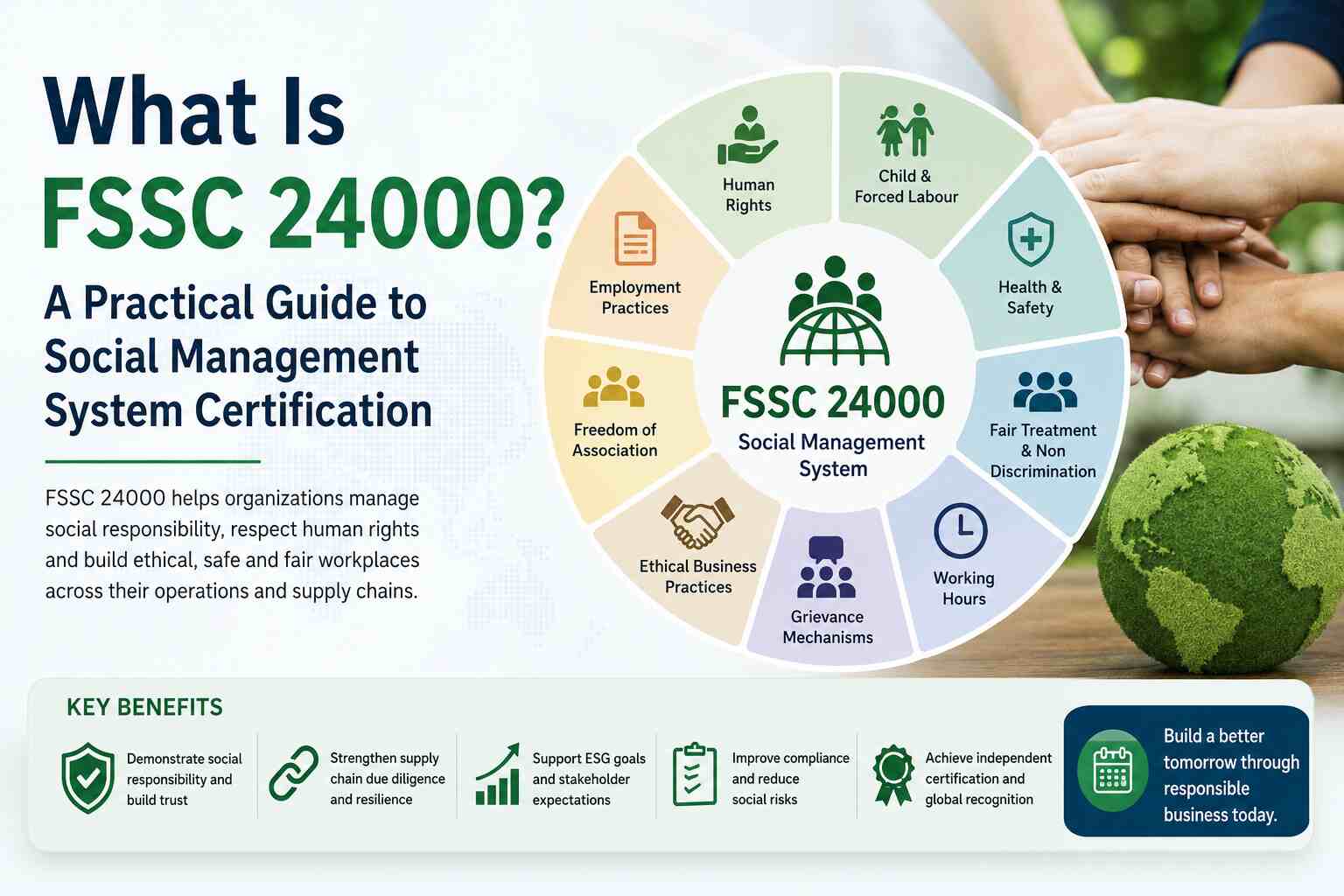
What Is FSSC 24000? A Practical Guide to Social Management System Certification
Social sustainability needs to be managed by organizations, just as they manage environmental sustainability and governance. Organizations must demonstrate that they have systems in place to protect their workers and respect human rights. Managing social sustainability in the value chain of an organization also involves identifying and managing risks.
This is where FSSC 24000 comes into focus.
The recognition of FSSC 24000 all over the world as a certification scheme for Social Management Systems, managed by the Foundation FSSC. This scheme of management for social sustainability provides organizations with a structural framework for the auditing of their social performance. This structure of FSSC 24000 for Social Management Systems is developed according to the well known ISO Management System approach and the ISO Harmonized Structure.
Within organizations that are already working with management systems for quality, environment or food safety, FSSC 24000 is the ideal tool to include social responsibility in the same management system environment.
In summary, this document has covered what FSSC 24000 does cover and how it could be of use to organizations. A brief overview of how certification is managed was also given.
Let us take a closer look.
What Is FSSC 24000?
The scheme provides organizations with a framework for managing social sustainability and improving social performance. Organizations can now show their social sustainability performance and demonstrate improvements.
PAS 24000 is a specification for Social Management Systems. FSSC 24000 incorporates the social performance requirements of PAS 24000 together with additional Scheme Requirements for the FSSC 24000 Scheme.
FSSC 24000 is not a simple way to check if an organization complies with a number of social issues in isolation. It is the basis for an organization’s social practices and therefore for its social sustainability. An organization therefore needs a policy on social sustainability, needs to assign responsibilities, identify potential social risks, put measures in place to deal with these risks, monitor the results and improve where necessary.
The scheme is applicable to the consumer goods industry and related supply chains, within both food and non-food sectors.
In practical terms, FSSC 24000 helps an organization move from saying:
We are committed to responsible working practices.
to being able to demonstrate:
We have a structured, implemented, monitored and independently auditable system for managing our social responsibilities…".
Why Are Social Management Systems Becoming Important?
Social sustainability is increasingly being given attention in addition to environmental sustainability. The two areas together form part of the ESG (Environmental, Social and Governance) framework.
A better understanding of how workers are treated in an organization’s operations and in its supply chains is becoming increasingly important to organizations.
Potential social risks can include:
-
Child labour
-
Forced or compulsory labour
-
Unsafe working conditions
-
Excessive working hours
-
Discrimination
-
Unfair employment practices
-
Restrictions on freedom of association
-
Ineffective grievance mechanisms
-
Human rights risks in supply chains
-
Unethical business practices
Occasional audits are not sufficient to manage risks and potential abuses of the above issues in order to set up an appropriate management structure.
Social Management Systems can identify, assess, control, monitor and improve social sustainability and human rights related risks on an ongoing basis in a structured manner.
FSSC 24000 is based on the management-systems philosophy.
What Does FSSC 24000 Cover?
FSSC 24000 – a foundation for Social Sustainability and Labour Rights.
Key areas covered by the scheme include:
1. Human Rights
Human Rights - Recognize and respect the human rights of employees and people affected by your organization.
This includes identification of social risks within your own organization and due diligence on the rest of your supply chain where necessary.
2. Child Labour
Systems to prevent and solve cases of child labor are needed by organizations.
The Foundation FSSC describes how a systematic approach to identifying and managing the risks of child labor can be developed by an organization.
3. Forced and Compulsory Labour
Forced labour remains a significant supply-chain risk globally.
Processes must be established to identify any situations in which Forced or Compulsory Labour could occur and appropriate action must be taken to prevent and remediate any instances where it has occurred.
4. Health and Safety
Healthy workers are important for a responsible workplace.
FSSC 24000 outlines the requirements for occupational health and safety within an organization’s social performance.
5. Building Safety
A major part of an organization’s activities take place in the workplace. So the physical environment and facilities of a workplace must offer the best possible protection to workers.
Risks related to working environments and facilities must be managed as part of an organization’s social performance.
6. Freedom of Association
Workers have the right to form or join trade unions of their choice including joining or forming employer-specific worker organizations to represent their interests with their employer or with third parties.
Organizations need appropriate processes and measures to respect the rights of workers relating to freedom of association and representation.
7. Discrimination and Fair Treatment
Such social problems need to be managed through the Social Management System so that employees are treated fairly and no types of discrimination occur. If they do occur, such social problems need to be addressed as well as resolved in an effective and responsible manner.
Discrimination in respect of recruitment, employment conditions, remuneration, promotion and termination of employment and/or outsourcing of work, and of treatment of employees at work.
8. Employment and Contractual Relationships
Employment relationships should be properly documented and managed.
An important social-performance area for organizations is the nature of their employment relationships (Employment and Contractual Relationships).
9. Working Hours
Working time represents another important social-performance area.
An organization should have a system to record and manage working hours in order to manage related risks within its operations.
10. Grievance Mechanisms
Workers and other relevant stakeholders need suitable mechanisms through which concerns can be raised.
A very structured process has to be set up for dealing with complaints and grievances, so that these can be processed by an organization in a proper manner. In addition, Foundation FSSC has published a number of documents in this area.
11. Business Ethics
Social responsibility extends beyond employment conditions.
Accountability and ethical business conduct, such as responsible decision making, are critical components for a Social Management System that has value.
Social performance, monitored and managed as a separate module, enables a holistic social sustainability approach, moving beyond individual aspects’ compliance monitoring.
How Is FSSC 24000 Structured?
Working time (clause 10)
The management-system requirements of FSSC 24000 are presented in the familiar structure of the ISO Management System approach and ISO Harmonized Structure as used for standards like ISO 9001 or ISO 14001.
Important management-system clauses include:
Clause 4 – Context of the Organization
Clause 5 – Leadership
Clause 6 – Planning
Clause 7 – Support
Clause 8 – Operation
Clause 9 – Performance Evaluation
Clause 10 – Improvement
Social sustainability is not treated as an isolated activity.
A Social Sustainability Management System needs to be developed and implemented by an organization in order to effectively implement social sustainability. In order to do this, an organization first needs to understand its context. Then, leadership for social sustainability needs to be established. Next, an organization needs to identify risks and then allocate necessary resources. Afterwards, controls need to be implemented and monitored. Then, an organization needs to measure and monitor its performance. Finally, the Social Sustainability Management System of an organization needs to be improved.
FSSC 24000 vs ISO 26000: What Is the Difference?
FSSC 24000 and ISO 26000: Two Different Tools for Social Responsibility.
Guidance on social responsibility. Not a certification standard that can be audited.
FSSC 24000 is a voluntary third-party certification scheme that allows for an organization’s Social Management System to be audited and certified by third parties.
This distinction is important.
ISO 26000 gives guidance on Social Responsibility and has seven Principles. For Social Responsibility guidance not to be audited or certified, organizations can use ISO 26000 to get the best understanding of the seven Principles that form the Standard.
The difference between FSSC 24000 certification and ISO 26000 guidance for the implementation of Social Responsibility (SR) efforts and their related Social Management System (SMS) within an organization, is that FSSC 24000 can provide for certification of an organization’s SR efforts (auditable, third-party, independent).
What Are the Benefits of FSSC 24000 Certification?
Benefits of an FSSC 24000 certification for an organization.
Demonstrating Social Responsibility
An organization can demonstrate its Social Responsibility by certification of its Social Management System, certified after independent audit, within the framework of FSSC 24000.
Strengthening Human Rights Due Diligence
Supporting Human Rights Due Diligence. FSSC 24000 supports a systematic approach to identifying and managing social and human rights risks in an organization’s operations and supply chains.
Supporting ESG Objectives
More and more organizations are developing ESG strategies and social sustainability targets.
By setting up a Social Management System, an organization can translate its strategic objectives into policies, roles, procedures for implementation and concrete measures to be taken.
Improving Supply Chain Management
Organizations increasingly need visibility into social risks associated with suppliers and business partners.
FSSC 24000 supports the integration of due diligence into supply-chain management rather than treating responsible sourcing as a standalone exercise.
Increasing Stakeholder Confidence
Customers, employees, investors, business partners and other stakeholders increasingly expect organizations to demonstrate responsible business practices.
Independent certification gives assurance that the social responsibilities an organization takes on are actually embedded into a structured management system.
Supporting Continuous Improvement
A management system approach for certification is a continuous process of monitoring and improving the social sustainability targets of an organization.
Continuing assurance is required, in particular by monitoring performance, dealing with any nonconformities and improving the overall effectiveness of the management system.
How Does FSSC 24000 Certification Work?
Steps to FSSC 24000 Certification for most organizations.
Step 1: Understand the Requirements - PAS 24000 Management System requirements, PAS 24000 Annex A and FSSC 24000 Scheme Requirements.
-
PAS 24000 Management System requirements
-
PAS 24000 Annex A
-
FSSC 24000 Scheme Requirements
Step 2: Implement the Social Management System
The organization then sets up its Social Management System, which includes the necessary policies, procedures, responsibilities, controls, documentation and monitoring processes.
During a gap assessment potential areas for improvement are identified.
Step 3: Complete the Certification Audit
As a last step of the certification process the organization is audited by an auditor from the chosen Certification Body (initial certification audit).
Any identified nonconformities need to be appropriately addressed.
Step 4: Obtain and Maintain Certification
Following successful certification, the organization will enter into the ongoing certification cycle of FSSC 24000.
FSSC 24000 requires organizations to be under an annual surveillance audit and a recertification audit every 3 years in order to remain a certified organization.
The ongoing processes of the organization are secured through the Social Management System.
Can FSSC 24000 Be Integrated with Existing Management Systems?
Yes.
Organizations that already operate a Social Management System and are familiar with other management systems (e.g. ISO 9001, ISO 14001, FSSC 22000) can integrate elements of their Social Management System in their existing organizational processes, as FSSC 24000 follows the ISO Management System approach and the Harmonized Structure.
For example, existing processes relating to:
-
Internal audits
-
Management reviews
-
Corrective actions
-
Risk management
-
Document control
-
Competence and training
-
Performance monitoring
A great starting point for an integrated Social Management System are the existing processes of an organization.
FSSC 24000 is of most value for organizations that are already operating a mature management system.
Who Should Understand FSSC 24000?
Knowledge of FSSC 24000 can be valuable for several professional functions.
These include:
-
ESG and Sustainability Managers
-
Social Compliance Professionals
-
Compliance and Regulatory Professionals
-
Quality and Certification Managers
-
CSR Professionals
-
Internal and External Auditors
-
Consultants
-
Procurement Professionals
-
Supply Chain Managers
-
Human Resources Professionals
-
Manufacturing and Processing Industry Representatives
-
Professionals responsible for supplier assessment and responsible sourcing
It will also be useful to professionals that translate ESG/social sustainability commitments into practical organizational controls.
FSSC 24000 Is More Than a Social Audit
FSSC 24000 promotes a management-systems approach, to the Social Accountability and Audit.
A traditional social audit is often a ‘snapshot’ in time and does not necessarily create value for the organization that has been audited.
A Social Management System asks broader questions:
Who is responsible for social performance?
How are social risks identified?
What controls are implemented?
How are workers' concerns addressed?
How are suppliers evaluated?
How is performance monitored?
What happens when a nonconformity is identified?
How does management ensure continuous improvement?
Embedding social responsibility into daily business activities rather than concentrating on the audit or reporting of social responsibility.
Build Practical Knowledge of FSSC 24000
Understand the principles of FSSC 24000 to implement the requirements of FSSC 24000 in a proper and effective manner. In addition to the social performance requirements of the scheme, the clauses of a management-system, the implementation expectations of FSSC 24000 and the audit process of FSSC 24000 need to be understood.
The RRMA will offer a 3-day FSSC 24000 – Social Management System Workshop from September 28 to 30, 2026. During this workshop, participants will gain the necessary practical knowledge required for the implementation of FSSC 24000.
The program will cover topics including:Introduction to FSSC 24000
-
Child and forced labour
-
Health and building safety
-
Freedom of association
-
Fair treatment and discrimination
-
Employment relationships
-
Working hours
-
Grievance mechanisms
-
Business ethics
-
Human rights
-
Clauses 4–10
-
Audit planning and preparation
-
Nonconformities
-
FSSC 24000 additional requirements
-
Auditor qualification
Note: It is available online and offline and we will provide physical support at the Tata Institute of Social Sciences, Mumbai (TISS). We have mentioned RRMA program details and there are 20 seats for the September audit available for offline registration.
Take the Next Step in Understanding FSSC 24000
ESGers | Sustainability professionals | Compliance and Audit professionals | Procurement and Contracts professionals | Quality Management professionals | Responsible Sourcing professionals | Anybody interested in developing a Social Management System and auditing for these requirements.
FSSC 24000 Social Management System Workshop – 3 Days! Join RRMA’s 3-Day FSSC 24000 – Social Management System Workshop, 28–30 September 2026, and develop practical knowledge of the FSSC 24000 Social Management System, its requirements, the FSSC approach for implementation of the standard and the audit process.
→ Register for the FSSC 24000 Social Management System Workshop
Frequently Asked Questions About FSSC 24000
Is FSSC 24000 a certification standard?
The certification scheme for Social Management Systems, FSSC 24000, is a scheme which incorporates the social performance requirements of PAS 24000 into the FSSC Scheme requirements.
Is FSSC 24000 mandatory?
No. FSSC 24000 is a voluntary certification scheme. Organizations may decide to set up a Social Management System and report independently on their social sustainability and social performance in a structured manner.
What is the difference between FSSC 24000 and ISO 26000?
ISO 26000 contains a detailed description of Social Responsibility. The Standard can be used by organizations for guidance on Social Responsibility. The FSSC 24000 Social Management System (SMS) certification on the other hand is a standard which provides a framework for a third-party certification of an organization’s SMS.
What issues does FSSC 24000 cover?
FSSC 24000 is the ideal framework for organizations to manage and monitor their Human Rights, Child and Forced Labor, Freedom of Association, Discrimination, Worker Health and Safety, Employment Relationship, Working Hours, Business Ethics and Grievance Mechanisms.
How long does FSSC 24000 certification last?
The certification is granted for a period of three years. Within this period an annual audit is conducted, referred to as a surveillance audit, in order to check whether the organization under certification is still complying with the relevant certification requirements.
Conclusion
While having policies in place is no longer sufficient, organizations are now expected to demonstrate their social sustainability, their ethical supply chains and their human rights due diligence.
When requirements for social sustainability are increasingly expected by stakeholders, having policies alone is not sufficient anymore. Rather, an organization must have systematic processes in place that enable identification of risks, designation of responsibility, implementation of controls, measurement of performance and ongoing improvement.
FSSC 24000 allows organizations to set up a social sustainability program and provide evidence of their social performance in a structured way and by third party verification.
Strengthening your social performance by integrating social responsibility into your formal management system, conducting due diligence on your supplies and giving assurance to your employees, customers and other stakeholders about your responsible business practices.
For professionals working in areas such as ESG, sustainability, compliance, auditing, procurement and management systems, having practical knowledge of how FSSC 24000 works and what it entails is essential to be able to deal with future developments around responsible business and social sustainability.

Dr. Manisha Karale
Dr. Manisha Karale is a Program Manager at RRMA, managing regulatory research, industry-academic collaborations, internships, and certificate courses for regulatory professionals. She mainly works on regulatory affairs in various sectors, including chemical compliance, food contact materials, cosmetics, sustainability, etc., contributing to regulatory intelligence and client reports. She holds a Master’s in Biochemistry and a Ph.D. in Environmental Science.
Submit your email ID to receive notifications about upcoming courses and events