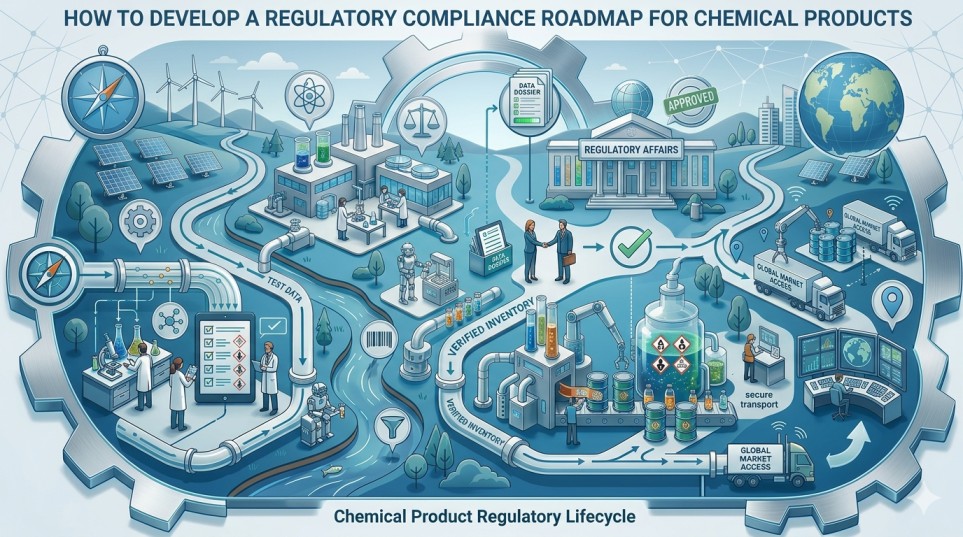
How to Develop a Regulatory Compliance Roadmap for Chemical Products
A regulatory compliance roadmap organizes required steps to identify applicable requirements, to check for any compliance gaps, to assign responsibilities and to prepare required actions to fulfill any obligations. A regulatory compliance roadmap for companies trading chemical products in several countries helps avoiding unknowns, delays and ensures safe market access.
What Is a Regulatory Compliance Roadmap?
A market a chemical product or to maintain or extend an already marketed product.
It helps organizations answer key questions such as:
-
Which regulations apply to the product?
-
What substances are present in the product?
-
Are registration, notification, or reporting obligations required?
-
What documentation is needed?
-
Are there deadlines or transitional periods to consider?
-
Who is responsible for completing each compliance activity?
-
What actions must be taken before market entry?
In the past, organizations had to react to single requirements, which led to problems. With a regulatory compliance roadmap, companies are able to prepare for the required steps for market placement of chemical products in a structured way in advance.
Why Chemical Companies Need a Compliance Roadmap
complexity of chemical regulations on a global market is increasing continuously. For companies this means that in addition toThe the usual aspects (e.g. chemical inventory, hazard classification, safety data sheet, labeling of preparations etc.) also aspects like restricted substances, product-specific requirements and the communication with suppliers and service providers in the supply chain have to be taken into account.
Without a clear roadmap, companies may face:
-
Delays in product launches
-
Unexpected registration or testing costs
-
Missing or incomplete documentation
-
Incorrect classification or labelling
-
Supply chain disruptions
-
Non-compliance penalties
-
Loss of market access
A roadmap aligns companies’ required actions with their commercial activities. Thus, compliance is addressed and planned early on, as opposed to merely being a matter for administration that is dealt with just in time for the start of sales.
Step 1: Define the Product and Market Scope
Define the chemical product and the markets in which it will be manufactured, imported, distributed or sold.
-
This includes identifying:
-
Product name and intended use
-
Substance or mixture composition
-
Concentration ranges of ingredients
-
Annual tonnage or expected volume
-
Target countries or regions
-
Role of the company in the supply chain
-
Customer type and industry sector
Regulatory requirements are often determined by a company’s role in the supply chain and market of placement (e.g. requirements of a manufacturer can differ from those of an importer, distributor or downstream user).
Step 2: Map Applicable Chemical Regulations
Once the product and market scope are defined, the next step is to identify the relevant regulatory frameworks.
Depending on the jurisdiction, chemical products may be subject to requirements related to:
-
Chemical inventory listing
-
Hazard classification and labelling
-
Restricted or prohibited substances
-
Industrial chemical management
-
Environmental, health, and safety requirements
-
Sector-specific regulations
-
Transport and storage rules
For companies operating internationally, this step may involve comparing multiple regulatory systems and understanding how requirements differ across countries.
Step 3: Conduct a Compliance Gap Assessment
Following from the identification of the relevant requirements for a product, a company assesses the current degree of compliance with these requirements.
The assessment is typically aimed at determining whether the necessary information, documentation and processes for the required compliance are already in place at the company.
Typical questions include:
-
Is the product listed on the relevant chemical inventory?
-
Are all substances properly identified?
-
Is the Safety Data Sheet compliant with local requirements?
-
Is the classification of the substances in the product in line with the implemented version of GHS?
-
Are there any restricted substances in the formulation?
-
Is registration or notification required?
-
Are exposure, toxicological, or ecotoxicological data available?
-
Are supplier documents complete and reliable?
-
Are there upcoming regulatory deadlines?
The objective of this step is to clarify what is missing and what has to be changed in order to declare the product to be compliant.
Step 4: Prioritize Regulatory Actions
Not all actions within compliance have the same level of urgency. There are certain requirements that must be fulfilled before a product can be launched to the market. Other requirements are an ongoing task to keep fulfilling.
-
Actions can be prioritized based on:
-
Legal deadlines
-
Market entry timelines
-
Business risk
-
Product volume
-
Regulatory complexity
-
Data availability
-
Customer requirements
-
Cost and resource impact
A missing registration requirement for the product to be able to enter the market would be considered a high priority item. Improvement of internal documentation is important but less of an urgent requirement as the product is currently compliant for sale.
The compliance roadmap has to clearly separate the immediate actions with urgent compliance requirements and the medium- and long-term compliance tasks.
Step 5: Assign Responsibilities and Timelines
The compliance roadmap needs to be practical and actionable, i.e. each task has to be assigned to a person, a department or to an external expert.
Common stakeholders may include:
-
Regulatory affairs teams
-
Product development teams
-
EHS departments
-
Quality assurance teams
-
Sales and business development teams
-
Legal departments
-
Supply chain teams
-
External regulatory consultants
-
Testing laboratories
Assigning responsibility and mapping out realistic time frames to complete tasks such as collecting data, testing and holding discussions with suppliers and submitting for authority under relevant legislation, is critical to a pragmatic compliance roadmap that avoids delays and holds individuals accountable.
Step 6: Prepare the Required Documentation
Documentation is a crucial part of chemical compliance in addition to meeting technical specifications. Companies must be able to prove compliance by means of accurate and up-to-date documentation.
Key documents may include:
-
Safety Data Sheets
-
Product composition records
-
Substance identification documents
-
Classification and labelling records
-
Registration or notification dossiers
-
Test reports
-
Exposure assessments
-
Risk assessment documents
-
Supplier declarations
-
Certificates of compliance
-
Regulatory correspondence
-
Internal compliance checklists
A roadmap should outline which documentation is required and who is responsible for preparing it. It should also outline when each document will be completed.
Step 7: Monitor Regulatory Changes
The compliance roadmap has to be dynamic as chemical regulations are frequently updated with new guidelines, draft laws, amendedA lists of substances of very high concern, restricted substances, changed classification and new reporting requirements.
-
Companies should monitor:
-
Regulatory news and updates
-
Draft regulations and public consultations
-
New substance restrictions
-
Changes in classification requirements
-
Deadlines for registration or notification
-
Updated guidance from authorities
-
International regulatory trends
Monitoring allows for the roadmap to be updated in good time and companies to prepare for upcoming requirements.
Step 8: Integrate Compliance into Business Planning
Linking regulatory compliance to the company’s business decisions. When planning the launch of a new product, entering a new market, changing suppliers, reformulating a product or increasing production volume, early consideration of the compliance implications is essential.
A regulatory roadmap can help to link compliance to business planning by outlining the key points that need to be considered for a company with certain goals and activities.
-
Will the product be able to be sold on the target market?
-
What compliance costs may apply
-
How long registration or notification may take
-
Whether additional testing is required
-
Whether product claims, labelling, or documentation need revision
-
Whether a market entry plan is realistic
Avoid last minute compliance barriers and make informed business decisions.
Common Mistakes to Avoid
Common mistakes organizations make when developing a regulatory compliance roadmap for their products and materials include:
-
Treating compliance as a one-time checklist
-
Assuming one country’s compliance status applies globally
-
Ignoring substance-level obligations
-
Using outdated Safety Data Sheets
-
Failing to verify supplier data
-
Missing regulatory deadlines
-
Overlooking changes in product composition
-
Not assigning clear responsibility for compliance actions
-
Waiting until product launch to assess requirements
An effective roadmap is started early, reviewed on an ongoing basis and treated as a working document for all relevant functions.
How Regulatory Training Supports Better Compliance Roadmaps
Creating an effective compliance road map requires more than just knowing that rules and regulations exist. To be of value, individuals need to understand how chemical regulations apply and how to interpret compliance requirements. These compliance requirements need to then be translated into actionable steps that support business objectives.
This is where structured training becomes valuable.
RRMA’s Professional Regulatory Program provides training to help professionals improve their knowledge of chemical compliance, in addition to supporting professionals and companies in becoming more regulatory ready and informed of global chemical regulations. The RRMA Professional Regulatory Training program provides a structured learning environment in which students can gain knowledge and skills to effectively support a company’s compliance planning and to interpret obligations under regulations in order to strengthen a company’s internal compliance system. Skills and knowledge can be applied by professionals in the areas of regulatory affairs, compliance, product stewardship, EHS, quality and business development.

Gaurav Mahajan
Gaurav has a master's degree in pharmacy, with a focus on Pharmaceutics. His work is heavily influenced by the globally Harmonized System for the Classification and Labelling of Chemicals (GHS). With a larger perspective, he uses news, articles, and reports to keep professionals informed about GHS compliance. In addition to GHS, he seeks the creation and translation of Safety Data Sheets (SDS). He knows the Europe's Cosmetics framework very well.
Submit your email ID to receive notifications about upcoming courses and events