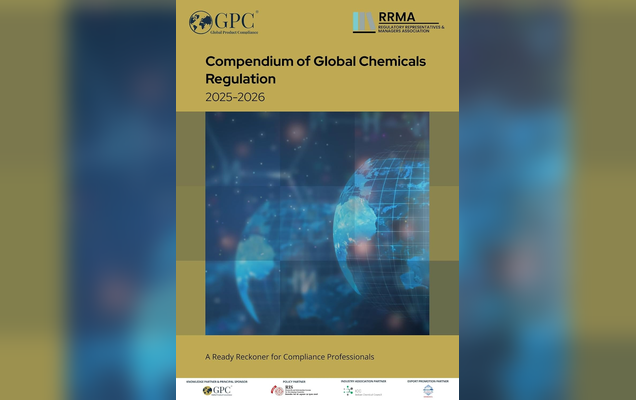
Compendium of Global Chemical Regulations (2025–2026)– The Essential Book for Globally Trading Chemical Enterprises.
For multinationals, importers, distributors, and manufacturers in the chemical industry, the task of ensuring compliance with chemical regulations has become increasingly complex. Requirements and deadlines are changing rapidly in countries around the world. Manufacturing facilities, distributors, and importers who fail to meet these requirements risk having shipments delayed or held, which in turn can cause manufacturers to miss critical market timelines, lose revenue, and harm their brand reputation.
What Is the Compendium of Global Chemical Regulations?
The Compendium of Global Chemical Regulations (2025–2026) from GPC Europe AB & RRMA offers access to more than 25 national and international chemical regulations and facilitates compliance with relevant requirements. The new Compendium is a part of GPC’s well-established annual Regulation Ready Series and is the most extensive Edition of the Compendium so far. This is the 11th Edition of the Regulation Ready Series.
📌 Key Fact:
No other reference work provides this unique single-volume coverage of over 20 different chemical regulatory schemes from around the world, including REACH, GHS, CLP, TSCA, Korea’s K-REACH, Turkey’s KKDIK, and Australia’s new AICIS scheme, and many more. All regulatory schemes are organised to allow daily compliance reference and use.
Whether you are the regulatory affairs manager responsible for the multi-market launch of a product, the importer confirming SDS requirements before the delivery of chemicals, or the consultant helping chemical companies to expand their activities to new markets, this reference work will save you a lot of time, because – unlike in lengthy legislative texts – you will find all the information you need on chemical regulations in the various markets in clearly arranged and easily understandable form.
Why Global Chemical Compliance Is Getting Harder
The global chemical regulatory environment is in a constant state of flux, with new requirements seemingly appearing on an almost monthly basis. Compliance teams are likely to find that the new year brings several changes for which they must develop strategies to achieve adherence to revised restrictions. This blog post will review four key updates that will become mandatory in the next 18 months, focusing on emerging trends in cosmetics regulations and additions to government-controlled lists of hazardous substances worldwide.
A ban on chemicals within the realm of newly enacted cosmetic regulations is set to take effect in South Korea in 2025, with Japan enforcing the policy in 2026. Consequently, manufacturers are strongly advised to remove banned substances from their product formulas before the effective dates
You will probably remember that we had advised that EU mixture classification for Endocrine-Disrupting Chemicals (EDCs) for single substances would be implemented in May 2025, and for mixtures in May 2026.
UK REACH gaps - Post-Brexit, the UK version of REACH will require separate registrations to those required under the EU scheme and a different timeframe for amendment.
KKDIK (Turkey REACH) – Mandatory temporary registrations need to be submitted by September 2026. An updated MoEUCC notice has recently been published.
For South Korea (K-REACH), we have updated the MSDS submission requirements as well as conducted new hazard assessments for 130 chemicals.
TSCA (USA) — Currently undergoing modernization and must comply with OSHA’s 2024 Hazard Communication rule with substance compliance deadlines that are projected to be in January 2026.
India has brought forth new regulations, titled India CMSR (India’s Chemicals Management and Safety Rules), that will require the government to maintain lists of regulated entities (manufacturers and importers) in addition to the chemical(s) of concern for which they are responsible.
Latin America - Several new deadlines are fast approaching for chemical registration in several countries in the region. Brazil, Argentina, Chile, and Colombia are all setting cut-off values that dictate the level of hazard classification required for the registration of chemicals.
The volume of jurisdictions with travel restrictions has grown to the point where manual research of government sources written in foreign languages is not tenable. Simply poring over spreadsheets and updating individual compliance lists is not enough.
What's Inside the 2025–2026 Edition
The Global Hazard Regulation Database (GHRD) is provided in a country-by-country format organised by the six continents listed below. The report provides a fast and easy comparison tool, organised by country, with each country report following a similar format.
🇪🇺 Europe
Compliance with regulatory requirements for the European Union (EU REACH/CLP), the UK post-Brexit (UK REACH), Ukraine (UA-REACH), and Russia (Russia TR 041). This document includes details of the ECHA fees applicable and the SME criteria.
Asia — East & Southeast
Comparison tables for building blocks of GHS between China MEE Order 12, K-REACH (South Korea), Japan CSCL, and Taiwan TCCSCA.
Asia — South & Middle East
Chemical regulations around the world. In India, KEACMSR details registration requirements for hazardous substances. In Turkey, KKDIK (Turkey REACH) governs chemicals with similar obligations to the EU REACH initiative.
North America
What’s next for TSCA modernisation (USA)? An update on CEPA reforms in Canada. An overview of the SNAc New Substances Program. A matrix outlining the chemical regulation in Mexico.
South America
Argentina, Brazil, Chile, and Colombia. The tables below provide a quick reference guide to the registration deadlines, hazard cut-off values, and country-specific exemptions for each country.
Oceania & Africa
AICIS (Australia) - Looking up Categorisation flowcharts and Import clearing costs; South Africa GHS label compliance.
Key Features That Make This the Professional's Choice
1. Country-by-Country Structure for Fast Navigation
All of the material is organised on a chapter by chapter country by country basis. Each chapter is structured in the same way. This means that those charged with conducting due diligence and also those responsible for ensuring that the compliance procedures are operating and working properly, across a range of jurisdictions, will be able to find the relevant material immediately and without confusion. There is no need to search through different books or portals for material applicable in different countries.
2. 75+ Data Tables Built for Operational Speed
Instead of ploughing through complicated legislation, the new reference guide does the hard work for you. The online Guide extracts key information on labelling requirements from complex legislation and displays it in a series of reference tables. These tabulated tables cover areas such as fees for the registration authority, minimum size for labels, details of SMEs, submission deadlines, and penalties for non-compliance. Compliance managers can easily check requirements for a forthcoming shipment destined for countries such as South Korea or Vietnam within minutes.
3. 20 Process Flowcharts for Complex Procedures
Clear step-by-step visual flowcharts are provided for the most complex processes. In addition to the Process for Preparing a K-REACH Joint Submission, flowcharts are available for the Process for the Australian AICIS introduction obligations as well as for the UK REACH transitional measures.
4. Forward-Looking Regulatory Intelligence
Each chapter where transitional provisions and future amendments will require changes to the code over time is highlighted. Many of the changes are currently due to become law several months in the future, but by planning for these changes early rather than entering a “fire-fighting” mode late is the most sensible approach.
5. Expert-Validated, Jargon-Free Content
All of our "regulatory summaries" are sourced from government texts and reviewed by the relevant specialist at GPC Europe AB. Our summaries are written so that those outside the legal sphere - technical, operational, and commercial staff - will easily understand the issues involved.
6. Multi-Continent Scope in a Single Volume
The only reference to cover Europe, Asia, North America, South America, Oceania, and Africa. The only reference to cater to the ever-growing businesses with global supply chains.
Endorsed by Industry Leaders
The Compendium has been reviewed and endorsed by senior individuals with knowledge and experience in the chemical, regulatory, and manufacturing sectors.
"Managing complexity is a hard task for today’s companies. The Compendium gives an overview of the current state of the art dealing with complexity and informs about the relevant experts and know-how."
— Mr. Anupam Kaul, Chair of the Executive Committee, RRMA, expressed his willingness to give this interview.
"Chemical regulation is a key element for gaining consumers’ trust and promoting innovation and sustainability. Harmonization of chemical controls between countries is an important approach to the protection of human health and environment, and conducting business in a globalised marketplace with trust."
— Mr. Ravi Kapoor, Chairman, Sustainability Committee, Indian Chemical Council (ICC).
"Regulations governing chemicals in several countries can make it difficult for those responsible for ensuring compliance within the supply chain. This much-needed book will provide the compliance professional with a 'one stop-shop' to assist in gaining an appreciation of the chemical regulations."
— Mr. Shisher Kumra, Executive Director, Global Product Compliance (GPC), Autodesk.
"Chemical regulation has evolved from a straightforward matter of compliance to a critical factor to a company's competitiveness as well as environmental, public health and safety, and customer expectations."
— Mr. Jitendra M. Patel, Managing Director, K. Patel Chemopharma Private Limited.
Who Should Read This Book?
- Chemical Manufacturing: Detailed information on country-specific label requirements and SDS requirements in the form of GHS building blocks. Browse by country name or enter country code.
-
Chemical Compliance Made Easy - Tabular data to aid the Chemical Compliance Professionals in making real-time decisions.
Our Regulatory Affairs Managers keep track of crucial deadlines, allowing BioCat to alert clients of upcoming market entry opportunities. By anticipating legislation and analyzing its potential impact, the team guides overall market strategy. In addition, they provide senior management with clear guidance for the registration of specific BioCat products in relevant markets.
- Importers & Manufacturers Don’t put your shipment, business, and reputation at risk due to ignorance of labeling requirements for the countries that you trade with. Avoid shipment delays, customs holds, and labelling fines by ensuring, in advance of shipment, that you understand all requirements for every country to which you export.
-
Regulatory Consultants use comparative data on country regulations in benchmarking policies or in counseling a multinational company entering a foreign market. The information can also be used to discuss foreign best practices in regulatory reform at the national or local level.
Frequently Asked Questions
- How often is the Compendium updated?
The Compendium is an annual publication and is part of GPC’s Regulation Ready Series of resources. This new publication is the 11th edition and provides information as of publication date on legislation, regulations, policies, effective and upcoming dates, and transitions affecting employers and employees with disabilities in the next year (2025–2026).
- Which chemical regulations does the Compendium cover?
This five-volume compendium covers major global, regional, and country-specific chemical regulatory requirements. A comprehensive reference for EU, UK, and global chemical regulatory requirements, including EU REACH / UK REACH, CLP / GHS, K-REACH / South Korea, China MEE Order 12 / Chemical Control Order, TSCA / CEPA, KKDIK / AICIS, CMSR / India, and many other jurisdictions. More than 25 countries are covered across 6 continents, as well as a detailed analysis of 20+ regions, including Latin America, Southeast Asia, the Middle East, and South Africa.
- Is this suitable for professionals who are not lawyers?
Yes, this guide is available to non-lawyers. This guide is intended for use by professionals who are not lawyers.
This publication is written without legal speak to be used by technical, compliance, and commercial staff, in addition to purchasing managers. The country chapters provide key requirements in easy-to-understand language, and these are illustrated with tables and flowcharts rather than the text of legislation.
- How can I purchase the Compendium?
The Compendium is available online at Amazon, published at ₹5,000 INR. For Institutional Copies and bulk orders, kindly contact manisha@rrma-global.org.

Dr. Manisha Karale
Dr. Manisha Karale is a Program Manager at RRMA, managing regulatory research, industry-academic collaborations, internships, and certificate courses for regulatory professionals. She mainly works on regulatory affairs in various sectors, including chemical compliance, food contact materials, cosmetics, sustainability, etc., contributing to regulatory intelligence and client reports. She holds a Master’s in Biochemistry and a Ph.D. in Environmental Science.
Submit your email ID to receive notifications about upcoming courses and events