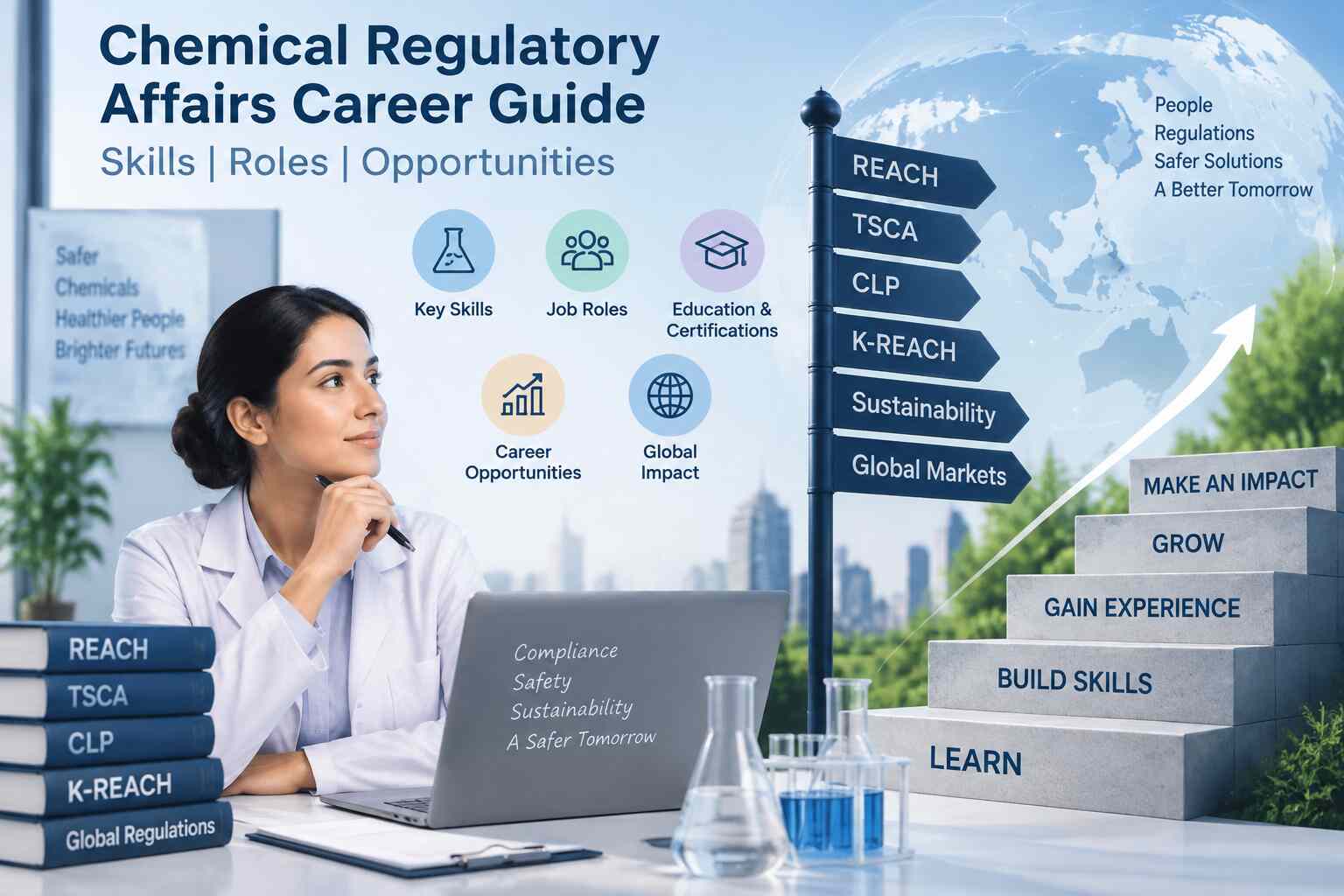
Chemical Regulatory Affairs Career Guide: Skills, Roles and Opportunities
Chemical regulatory affairs is a field that combines scientific knowledge of chemicals, understanding of the relevant legislation, managing of data and communication with colleagues and authorities. As a result of the growing need for experts on these subjects, there are many career opportunities within chemical regulatory affairs.
Whether you are a recently graduated chemistry student looking for a career, an Environmental expert looking for specialization or an experienced Regulatory Affairs expert looking for new challenges and further development within the industry, the field of Chemical Regulatory Affairs offers a wide range of different career opportunities within various industries all over the world.
What Is Chemical Regulatory Affairs?
Chemical regulatory affairs is a functional area that has to ensure that all chemical products during their complete product life cycle (research & development, manufacture, import, application, disposal) are complying with all applicable regulations.
Regulatory professionals work with various global frameworks, including:
-
EU REACH (Registration, Evaluation, Authorisation and Restriction of Chemicals)
-
CLP Regulation (Classification, Labelling and Packaging)
-
UK REACH
-
US TSCA (Toxic Substances Control Act)
-
K-REACH (Korea)
-
Chemical inventory requirements in different countries
-
Hazard communication and safety data sheet requirements
As part of an organization, a Regulatory Affairs professional can assist a company understand updates to legislation, prepare compliance documents, communicate with government bodies and establish a strategy to allow continued market access.
Why Choose a Career in Chemical Regulatory Affairs?
The importance of regulatory affairs specialists is increasing due to growing demands on chemical safety, sustainability and responsible manufacturing.
There are several key drivers behind the increasing need for skilled Regulatory Specialists.
1. Increasing Global Chemical Regulations
These regulations are constantly changing in countries around the world, to protect the health and environment of citizens. In the market in which a company operates internationally, specialists with in-depth knowledge of the various national regulations are required to enable companies to meet the applicable requirements and to develop optimal compliance strategies.
2. Growing Importance of Product Compliance
Increasing importance of chemical compliance to become a strategic business topic. Non-compliance with legal requirements to register products on the market has effects on the whole supply chain and even on customer relationships.
The work of the Regulatory Specialist can help identify requirements prior to potential problems with non-compliance occurring.
3. Expansion of International Trade
The chemical market is increasingly moving across borders and thus needs regulatory expertise when exporting chemicals, formulations or finished products to other countries.
They can also support companies that wish to enter new markets.
4. Focus on Sustainability and Emerging Regulations
New regulatory areas such as:
-
PFAS restrictions
-
Microplastics regulations
-
Sustainable chemical management
-
Circular economy requirements
-
Digital Product Passports
Providing potential for people’s careers in these emerging fields.
Key Roles in Chemical Regulatory Affairs
The field of chemical regulatory affairs offers a range of jobs for people of different ages and backgrounds with relevant amounts of experience and specialized knowledge.
1. Regulatory Affairs Associate
As an entry-level job, a Regulatory Affairs Associate supports activities within the area of compliance.
Typical responsibilities include:
-
Collecting chemical substance information
-
Reviewing regulatory requirements
-
Supporting registration activities
-
Preparing regulatory documentation
-
Maintaining compliance databases
-
Assisting senior regulatory teams
As an entry-level position, the position helps develop in-depth knowledge of the processes of regulating chemicals as well as the corresponding market practices.
2. Regulatory Affairs Specialist
Regulatory specialists for compliance activities typically are supporting specific regions or even specific regulations like EU REACH, CLP, TSCA or other.
Responsibilities may include:
-
Evaluating chemical regulatory requirements
-
Preparing registration dossiers
-
Managing chemical notifications
-
Reviewing Safety Data Sheets (SDS)
-
Supporting classification and labelling activities
-
Monitoring regulatory updates
Experts specialize in certain regulatory frameworks such as the EU REACH-CLP-Guide, TSCA or other country specific legislation.
3. Regulatory Consultant
Regulatory consultants advise companies on a consultative basis and help them to develop the necessary measures to meet regulatory requirements.
Their work may involve:
-
Regulatory gap assessments
-
Market entry evaluations
-
Compliance strategy development
-
Registration support
-
Regulatory interpretation
-
Client advisory services
Consulting roles enable Specialists to gain experience in a variety of industries, with different products and in different regions worldwide.
4. Regulatory Intelligence Analyst
The role of a Regulatory Intelligence Analyst is to monitor and analyze regulatory developments.
Their responsibilities include:
-
Tracking upcoming legislation
-
Assessing regulatory impacts
-
Preparing regulatory updates
-
Supporting business decision-making
Identifying future compliance risks
This is a role that is becoming increasingly important as regulatory changes are implemented across the globe at an ever increasing pace.
5. Regulatory Manager
Their main area of work is managing a team of regulatory experts and developing a compliance strategy within a company.
Their responsibilities include:
-
Managing regulatory teams
-
Developing compliance strategies
-
Communicating with authorities and stakeholders
-
Supporting product development decisions
-
Ensuring global regulatory alignment
After some years of experience, Regulatory Managers can become Global Regulatory Directors.
Essential Skills Required for Chemical Regulatory Affairs Professionals
A successful career in regulatory affairs can be built using technical, analytical and communication skills.
1. Understanding of Chemical Regulations
A strong foundation in regulatory frameworks is essential.
Professionals should understand:
-
Chemical registration processes
-
Hazard classification principles
-
Safety Data Sheet requirements
-
Chemical inventories
Regulatory obligations for manufacturers, importers, and downstream users
Knowledge of multiple jurisdictions can lead to additional career opportunities.
2. Scientific Knowledge
Typically a graduate of a program in chemistry, chemical engineering, toxicology or environmental science, etc.
Scientific knowledge helps professionals interpret:
-
Chemical properties
-
Hazard information
-
Exposure considerations
-
Risk assessment data
3. Data Management Skills
Much technical information is processed in the field of Regulatory Affairs.
Professionals should be comfortable working with:
-
Regulatory databases
-
Chemical inventories
-
Registration dossiers
-
Compliance documentation
-
Digital regulatory platforms
This attention to detail is crucial for completing accurate regulatory submissions.
4. Communication Skills
Regulatory professionals frequently collaborate with:
-
Scientists
-
Product development teams
-
Suppliers
-
Customers
-
Government authorities
This ability to communicate clearly is an important skill for a Regulatory Specialist.
5. Analytical and Problem-Solving Skills
Regulatory specialists often need to evaluate:
-
New regulatory obligations
-
Compliance gaps
-
Market access challenges
-
Alternative approaches for meeting requirements
Strong analytical thinking helps professionals develop practical compliance solutions.
Educational Background and Certifications.
Many professionals enter chemical regulatory affairs with backgrounds in:
-
Chemistry
-
Chemical engineering
-
Pharmacy
-
Environmental science
-
Toxicology
-
Life sciences
However, formal education in regulatory affairs is not sufficient to start a career in Chemical Regulatory Affairs.
Professionals can enhance their skills through specialized training programs focusing on:
-
Chemical regulations
-
Regulatory documentation
-
Global compliance frameworks
-
Hazard communication
-
Risk assessment principles
Foundational learning programs, such as the regulatory affairs courses provided by RRMA, provide the learning ground for students and working professionals alike to gain knowledge on key regulatory issues and become aware of global chemical compliance requirements before specializing.
Continuing to develop your skills at industry events, in professional circles or by updating yourself on regulatory changes is necessary, as the chemicals legislation is constantly changing.
Educational Background and Certifications
Many professionals enter chemical regulatory affairs with backgrounds in:
-
Chemistry
-
Chemical engineering
-
Pharmacy
-
Environmental science
-
Toxicology
-
Life sciences
However, formal education in regulatory affairs is not sufficient to start a career in Chemical Regulatory Affairs.
Professionals can enhance their skills through specialized training programs focusing on:
-
Chemical regulations
-
Regulatory documentation
-
Global compliance frameworks
-
Hazard communication
-
Risk assessment principles
Foundational learning programs, such as the regulatory affairs courses provided by RRMA, provide the learning ground for students and working professionals alike to gain knowledge on key regulatory issues and become aware of global chemical compliance requirements before specializing.
Continuing to develop your skills at industry events, in professional circles or by updating yourself on regulatory changes is necessary, as the chemicals legislation is constantly changing.
Career Growth Opportunities in Chemical Regulatory Affairs
Career Growth Opportunities in Chemical Regulatory Affairs
Career opportunities in Chemical Regulatory Affairs are available in various industries.
-
Chemicals and petrochemicals
-
Pharmaceuticals
-
Cosmetics
-
Agrochemicals
-
Consumer products
-
Manufacturing
-
Specialty chemicals
-
Consulting organizations
Professionals can progress through career stages such as:
Regulatory Associate → Regulatory Specialist → Senior Regulatory Specialist → Regulatory Manager → Global Regulatory Lead
With international experience in the field of regulatory affairs you can also work for multinational companies and global consulting organizations.
Industries Hiring Chemical Regulatory Professionals
Demand exists across many sectors, including:
Chemical Manufacturing
The company needs regulatory experts to register and classify chemicals and to obtain market access.
Pharmaceutical Industry
Regulatory professionals support compliance of active ingredients, excipients, and related z
Experts assist companies with ingredient restrictions, safety requirements as well as regional regulations.
Agrochemical Industry
These professionals are responsible for the registration of pesticides and other agrochemicals, as well as fertilizers and other related products.
Regulatory Consulting
Their work may involve different clients, working within different global regulatory frameworks.
Future Trends in Chemical Regulatory Careers
The field of regulatory professionals is rapidly evolving due to new technologies as well as global developments and challenges.
Future opportunities will increasingly involve:
Digital Regulatory Management
Companies are implementing digital solutions to manage regulatory data, to automate compliance processes and to obtain regulatory intelligence.
Artificial Intelligence in Regulatory Affairs
Support regulatory monitoring, data analysis, and document management with AI-based tools.
Sustainability-Focused Compliance
People familiar with sustainable chemistry, the key environmental regulations, as well as recent and upcoming restrictions will be in high demand.
Global Regulatory Expertise
Companies operating on an international scale will require personnel familiar with the various national and international regulatory systems to support their global compliance strategies.
How to Start Your Career in Chemical Regulatory Affairs
A Beginner’s Guide to Launching a Career in Chemical Regulatory Affairs
If you are interested in a career in this field, read on for some steps to get you there!
Step 1: Build a Scientific Foundation
Get familiar with chemistry, chemical safety and toxicology as well as other related topics.
Step 2: Learn Regulatory Fundamentals
Understand major chemical regulations and compliance principles.
Step 3: Gain Practical Experience
Internships, training programs and entry-level regulatory jobs are ways to get some practical experience in the field.
Step 4: Develop Industry Connections
Being part of a regulatory association, following webinars and professional communities is very helpful to learn more about the requirements and to get in contact with people in the field.
Step 5: Continue Learning
These requirements change frequently and require continuous updating by professionals in this field.
Conclusion
The field of chemical regulatory affairs is rapidly expanding. Regulatory affairs in general combines the fields of science and compliance with communication and strategic planning. The global chemical regulations are constantly changing and many companies need employees to assist them with understanding the requirements to guarantee responsible market access.
By combining science, sustainability and international business, chemical regulatory affairs offers a range of career possibilities within different industries, all contributing to the responsible management of chemicals globally.
By gaining experience, continuing to further develop regulatory knowledge, and keeping up-to-date with global developments, people can help to build a successful and challenging career in this field.

Gaurav Mahajan
Gaurav has a master's degree in pharmacy, with a focus on Pharmaceutics. His work is heavily influenced by the globally Harmonized System for the Classification and Labelling of Chemicals (GHS). With a larger perspective, he uses news, articles, and reports to keep professionals informed about GHS compliance. In addition to GHS, he seeks the creation and translation of Safety Data Sheets (SDS). He knows the Europe's Cosmetics framework very well.
Submit your email ID to receive notifications about upcoming courses and events