World’s 1st Learning Program with Focus on Chemicals
Certified Regulatory Professionals Program (Chemicals)
Master global chemical regulatory frameworks and advance your compliance career with industry-recognized RRMA certification.



Program Overview
RRMA Certified Regulatory Professionals Program (Chemicals) is a program specifically designed for those who would like to learn and specialize in chemical product regulatory compliance, resulting in a Certified Regulatory Professionals (Chemical) Certificate from RRMA. It is the first ever program of its kind to offer chemical regulatory professionals the opportunity to get certified in their field.
The program covers essential topics related to regulatory compliance, safety standards, and best practices in handling chemical products. Through a combination of theoretical knowledge and practical applications, participants will gain a comprehensive understanding of compliance requirements and how to ensure adherence to regulations in their respective industries.
Key Learning Outcomes
- Understand regulatory professionals' role in compliance
- Understand Harmonized Classification system and compliance.
- Identify regulatory needs and compliance requirements.
- Know regulatory regime, technical standards, obligations.
- Interpret SDS and chemical safety assessments.
- Advise on compliance strategy and certifications.
- Understand regulatory professionals' role in compliance
- Understand Harmonized Classification system and compliance.
- Identify regulatory needs and compliance requirements.
- Know regulatory regime, technical standards, obligations.
- Interpret SDS and chemical safety assessments.
- Advise on compliance strategy and certifications.
Course Curriculum
Six comprehensive sections designed to build your expertise progressively, from foundational concepts to advanced compliance strategies.
-
- Significance and purpose of Technical Regulations
- Nature and types of Technical Regulations
- Non-Tariff Barriers to trade
- Role of WTO in world trade
- TBT Agreement
- SPS Agreement
- Other agreements - TRIPS , GATS
- This module highlights the importance of technical regulations, the challenges posed by non‑tariff barriers, and the central role of the WTO in promoting fair trade. Learners will explore key agreements such as TBT and SPS, which address standards and safety in global commerce. Broader frameworks like TRIPS and GATS are also covered, offering a complete view of how international trade is regulated and harmonized.
-
- "This module introduces the principles and scope of Good Laboratory Practice (GLP), emphasizing its purpose, use, and alignment with OECD standards. Learners will explore compliance monitoring, certification requirements, and the step‑by‑step certification process. The course also highlights the role of regulators in India, providing practical insights into how GLP ensures quality, reliability, and credibility in laboratory operations
- Processed foods
- Unprocessed Foods
- Pharma bulk, API, generics and patented drugs; cosmetics
- Chemicals
- Electrical equipment - industrial / consumer
- Machinery
- Medical devices
- Telecom equipment
- Fire safety equipment
- Equipment used in mines and explosive environments
- Boilers, pressure vessels, containers of gases and chemicals
- Construction materials – steels, cements, glass, furnishings
- Children’s products – toys, feeding bottles, seats,
- Vehicles
- Nuclear
- Aviation
- Marine
- This module examines the diverse range of products subject to technical regulations and SPS measures, spanning foods, pharmaceuticals, chemicals, and industrial equipment. It highlights critical sectors such as construction materials, children’s products, vehicles, and high‑risk industries like nuclear, aviation, and marine. Learners will gain a clear understanding of how regulatory frameworks protect consumers, ensure compliance, and strengthen trust in global trade.
-
- Essential requirements / Product Conformance requirements
- Adoption of voluntary standards for Conformance requirements
- Modes of Conformity Assessment practices used : Self Declaration, product certification, third party inspections, systems certification, combinations thereof
- Lead time and dates of enforcement (sunset clause where applicable)
- Methods of enforcement
- Designated agencies for conformity assessment, enforcement, market surveillance, appeals, resolutions
- Penalties for non-compliance
- This module provides a clear overview of product conformance requirements and the role of voluntary standards in global trade. It examines different modes of conformity assessment, enforcement timelines, and designated agencies responsible for compliance
-
- OECD principles of Good Regulatory practices
- Importance of stakeholder consultation
- Importance of transparency and communications in drafting, notifying technical regulations
- Evaluation of alternative measures
- This module emphasizes the OECD principles of good regulatory practices, highlighting the importance of stakeholder consultation in shaping effective policies. It underscores transparency and clear communication in drafting and notifying technical regulations. Learners will also explore the evaluation of alternative measures, gaining practical insights into building balanced and accountable regulatory frameworks.
-
- Evaluating the cost burden of implementation
- Evaluating the cost burden of enforcement
- Evaluating other burdens
- Evaluating impact on ease of doing business
- This module focuses on evaluating the cost and business impact of regulatory measures. Learners will examine the burden of implementation, enforcement, and other compliance requirements. It also highlights how these factors influence the ease of doing business, providing practical insights into balancing regulation with economic growth.
-
- Regulatory Bodies
- Administrative bodies / Licensing bodies
- Statutory committees
- Advisory bodies
- Notified third party agencies for conformity assessment
- Law enforcement agencies
- Adjudication bodies / authorities
- Market surveillance agencies
- INSS
- This module explores the diverse institutions that shape regulatory and compliance frameworks, including regulatory bodies, licensing authorities, statutory committees, and advisory groups. It highlights the role of notified third‑party agencies, law enforcement, adjudication authorities, and market surveillance organizations. Learners will gain a clear understanding of how these entities collectively ensure effective governance, accountability, and trust in regulatory systems
-
- Overview of FTAs – TBT/SPS chapters
- Bilateral
- Multilateral
- Securing acceptance of regulated products and services – FTAs or otherwise
- This module provides an overview of Free Trade Agreements (FTAs), focusing on TBT and SPS chapters that shape regulatory cooperation. It examines both bilateral and multilateral agreements while highlighting strategies to secure acceptance of regulated products and services. Learners will gain practical insights into how FTAs and related frameworks facilitate smoother market access and global trade integration.
-
- Understand the growing usage of standards in products, services, processes, and systems.
- Recognize the importance of conformity assessment in ensuring compliance with rules and voluntary standards.
- Learn about the international accreditation framework, which includes essential ISO/IEC standards.
- Learn about the role of accreditation in the regulatory and voluntary sectors.
- Understand the worldwide vision for a standardized conformity assessment procedure to enable international trade.
- Examine the Indian scenario in terms of accreditation, using examples from several sectors.
- This module explores the growing role of standards across products, services, processes, and systems, emphasizing the importance of conformity assessment in ensuring compliance. Learners will gain insights into the international accreditation framework, including ISO/IEC standards, and the role of accreditation in both regulatory and voluntary sectors. It also examines the global vision for standardized conformity assessment and highlights the Indian accreditation landscape through sector‑specific examples.
-
- Prohibitions from use
- Restrictions on use (quantitative, use based)
- Classification and Labelling
- Declaration of substance information
- Waste disposal practices
- Safe Transportation
- "This module examines key regulatory aspects for managing substances, including prohibitions, restrictions, and classification with proper labelling. Learners will explore requirements for declaring substance information, waste disposal practices, and safe transportation. Together, these elements provide a practical understanding of how compliance frameworks protect health, safety, and the environment while enabling responsible trade and industry operations.
-
- Purpose and objectives, scope, signatory countries, Rules of procedure, central managing organization, national rights and obligations, DNAs
- Chemical Weapons Convention
- Stockholm Convention on Persistent Organic Pollutants (POPs)
- Rotterdam Convention on the Prior Informed Consent Procedure
- Basel Convention on the Control of Transboundary Movements of Hazardous Wastes - and Their Disposal
- ILO Chemicals Convention Concerning Safety in the Use of Chemicals at Work
- Montreal Protocol on Ozone-depleting Substances
- This module explores key international conventions and protocols that govern chemical safety, hazardous substances, and environmental protection. Learners will study agreements such as the Chemical Weapons Convention, Stockholm and Rotterdam Conventions, Basel Convention, ILO Chemicals Convention, and the Montreal Protocol. Together, these frameworks provide a global perspective on managing risks, ensuring compliance, and safeguarding health and the environment.
-
- UNECE - Globally Harmonized System of Classification and Labelling of Chemicals – 1 hr
- "This module introduces the Globally Harmonized System (GHS) for classifying and labeling chemicals, focusing on its purpose and key components. Learners will explore hazard classes, pictograms, and communication elements such as hazard statements, precautionary statements, signal words, and Safety Data Sheets (SDS). It also covers the 16 SDS sections and highlights GHS’s role in standardizing chemical hazard communication across countries and regulatory frameworks
-
- UNECE - Model Regulations on the Transport of Dangerous Goods (Ver 22)
- UNECE - Agreement concerning the International Carriage of Dangerous Goods by Road (ADR 2023) (Bullet 2 &3 – 1 hr)
- "This module introduces the UN Model Regulations for transporting dangerous goods, covering classification, packaging, labeling, and documentation. Learners will understand the roles of shippers, carriers, consignees, and manufacturers in ensuring compliance, while exploring the link between ADR and GHS for hazard communication. It also highlights the impact of these frameworks on industry, trade, and safety, alongside essential emergency response measures for secure transport.
-
- REACH and reach like regulations.
- EU – REACH & Other REACH like regulations
- US, Australia
- China, Japan
- his module explores REACH and similar regulatory frameworks across regions, including the EU, US, Australia, China, and Japan. Learners will understand how these regulations govern chemical safety, compliance, and market access. By comparing REACH with regional adaptations, the course provides a global perspective on harmonized regulation and its impact on international trade and industry practices.
-
- Management systems and product certifications
- This module introduces learners to technical regulations and voluntary standards, highlighting the role of key organizations and private standards in shaping compliance. It explores management system standards (MSS) and quality management systems (QMS), while differentiating types of certification. Learners will also gain practical insights into conformity assessment processes that ensure credibility, trust, and global trade facilitation.
-
- Sustainability standards and certifications (Private)
- This module explores sustainability standards and certifications that drive responsible business practices across industries. Learners will understand how these frameworks promote environmental stewardship, social accountability, and ethical trade. It highlights the growing role of voluntary certifications in shaping global supply chains and building consumer trust in sustainable products and services."
-
- Bureau of Indian Standards Act, 2016, QCOs on Chemicals issued under the Act
- raft Indian Chemicals Safety Management Rules (EPA Act, 1986) (ICMSR)
- ChemIndia Portal
- Manufacture, Storage, and import of Hazardous Chemical Rules, 1989, Central Motor Vehicles Rules (CMVR), Chemical Accidents Rules 1996
- Petroleum and Natural Gas Regulatory Board (Codes of Practices for Emergency Response and Disaster Management Plan (ERDMP)) Regulations, 2010 (PNGRB)
- This module provides an overview of India’s regulatory framework for chemicals and hazardous substances, covering the BIS Act, QCOs, and draft ICMSR under the EPA Act. Learners will explore key rules on manufacture, storage, import, and accident management, alongside sector‑specific regulations like CMVR and PNGRB’s ERDMP codes. It also introduces the ChemIndia Portal, offering practical insights into compliance, safety, and emergency preparedness in the chemical sector.
-
- Introduction to REACH (Registration, Evaluation, Authorisation, and Restriction of Chemicals),
- CLP (Classification, Labelling, and Packaging), RoHS Directive (Directive 2011/65/EU), Toy Safety Directive (Directive 2009/48/EC).
- Chemicals strategy for sustainability
- This module introduces the EU’s REACH regulation, alongside related frameworks such as CLP, RoHS, and the Toy Safety Directive. Learners will explore how these regulations govern chemical registration, classification, labeling, and product safety. It also highlights the EU Chemicals Strategy for Sustainability, offering insights into the future direction of regulatory policy and sustainable chemical management.
-
- China – MEE Order No. 12 (New Chemical Substances), GHS implementation, Dangerous Goods Transport Regulations
- Japan – Chemical Substances Control Law (CSCL), Industrial Safety and Health Law (ISHL)
- South Korea – K-REACH, Chemical Control Act (CCA)
- Taiwan – TCSCA, Occupational Safety and Health Administration (OSHA) chemical management rules
- ASEAN Countries – Thailand Hazardous Substances Act, Vietnam Law on Chemicals, Singapore Environmental Protection and Management Act (EPMA) / Workplace Safety and Health (WSH) regulations
- This module provides a comparative overview of chemical management and safety regulations across Asia, including frameworks in China, Japan, South Korea, Taiwan, and ASEAN countries. Learners will explore laws governing new chemical substances, occupational safety, and environmental protection, alongside GHS implementation and transport rules. The course highlights regional approaches to compliance, offering insights into harmonized practices and cross‑border regulatory alignment.
-
- United States – Toxic Substances Control Act (TSCA), OSHA Hazard Communication Standard (HazCom), EPA regulations on hazardous chemicals
- Canada – Canadian Environmental Protection Act (CEPA), Domestic Substances List (DSL)
- Latin America – Brazil Industrial Chemicals Inventory (under development), Chile’s Chemical Safety Regulations (aligned with GHS), Argentina’s Chemical Management Frameworks
- "This module provides an overview of chemical regulatory frameworks across the United States, Canada, and Latin America. Learners will explore key laws such as TSCA, OSHA HazCom, CEPA, and emerging inventories and safety regulations in Brazil, Chile, and Argentina. The course highlights how these systems govern hazardous substances, align with GHS, and shape compliance, safety, and trade practices across the Americas

Mr. Anil Jauhri
Former CEO of the National Accreditation Board for Certification Bodies (NABCB)
Mr. Anil Jauhri is the Former CEO of the National Accreditation Board for Certification Bodies (NABCB), Quality Council of India, and currently Lead Assessor at NABCB. He is Co-Chair at RRMA, as well as Chairman at Steering Committee, GCPPCS, CDSA_THSTI. Mr. Jauhri has extensive experience in the regulatory field and was with the Bureau of Indian Standards (BIS), the national standards body, for over 25 years, having key roles and positions in the organization. Mr. Jauhri also worked as Adviser in the Export Inspection Council, India’s export regulator and certifying agency under Department of Commerce (2000-2003).
Teaching Sections:
Section- 1

Mr.Anupam Kaul
Leads standards, quality management, and risk management initiatives at the CII Institute of Quality
Mr. Anupam Kaul, with over 38 years of experience, leads standards, quality management, and risk management initiatives at the CII Institute of Quality. He has been a key figure in the development of ISO standards and the Indian National Strategy for Standardization. He leads these initiatives at the CII Institute of Quality and has played a pivotal role in the development of key ISO standards, including ISO 9001, ISO 9004, and ISO 37500. Anupam has been instrumental in initiating training programs on Accreditation Standards in India, training over 800 certification and inspection auditors, and helping more than 10 bodies achieve accreditation. He also played a key role in developing the Indian National Strategy for Standardization, a significant policy document guiding India’s standards-related efforts for the coming years. He is actively involved in national committees like BIS and NABCB and plays a crucial role in India's standards and regulatory dialogues with countries such as the USA and Germany.
Teaching Sections:
Section- 1

Dr. Bhupendra Kumar Rana
CEO, Quality & Accreditation Institute (QAI).
Dr. Bhupendra Kumar Rana, who is the CEO of the Quality & Accreditation Institute (QAI). Prior to the current assignment, he was Director & CEO-In-Charge of NABH, Quality Council of India. He holds a Ph.D. in Biochemistry, a Diploma in German and a Post Graduate Diploma in Hospital and Health Management. He is a Founding Member of the International Academy of Quality & Safety (IAQS) and member of the Scientific Advisory Board, International Alliance of Patients’ Organizations (IAPO).
Teaching Sections:
Section- 1

Ms. Shobha Hegde
Expert in Conformity Assessment with over 40 years of experience
Mrs. Shobha Hegde is an expert in Conformity Assessment with over 40 years of experience, including roles in Product Certification, Laboratory Management, and as a Scientist ‘F’ at BIS, Mumbai. Post-retirement, she continues to lead accreditation and certification bodies, contributing significantly to global standards and quality assurance through her work with NABL, NABCB, and UNFCCC programs.
Teaching Sections:
Section- 1Section- 3

Mr. Shisher Kumra
Founder and Chief Executive of GPC Group
Mr. Shisher Kumra is an Environmental Law and Policy expert with 3 decades of experience in the areas of Sustainability management, cleaner production and technology, support chemical policy and regulation, regulatory representation, and setting up compliance management systems. Mr. Kumra as the Founder and Chief Executive of GPC Group has supported global compliance excellence efforts of 1500+ corporations across the world.
Teaching Sections:
Section- 2

Dr. Vaibhav Diwan
General Manager (Growth) at GPC
Dr. Vaibhav Diwan is a leading professional in the global chemical regulatory space. He is an expert in establishing regulatory compliance as an opportunity for business growth in the chemicals sector and related sectors. As General Manager (Growth) at GPC, he works with the senior management of multinational companies, helping them grow across the global market space by strategically addressing compliance challenges. He holds a Ph.D in Life Science (Molecular Biology and Microbiology).
Teaching Sections:
Section- 2

Dr. Manisha Karale
Program Manager at RRMA.
Dr. Manisha Karale is a Program Manager at the Regulatory Representative Managers Association (RRMA). She manages regulatory research activities, regulatory research internship and apprenticeship, industry-academic collaborations, writing review articles, and research grant proposals. She is involved in the development and management of certificate courses for students and regulatory professionals. She mainly works on regulatory affairs in various sectors, including chemical compliance, food contact materials, cosmetics, sustainability, etc. She contributes to content development for the regulatory intelligence portal and regulatory reports for clients’ queries. She holds a master’s in Biochemistry and a Ph.D. in Environmental Science.
Teaching Sections:
Section- 2

Mr. Sorosh Ziarat
Regulatory Coordinator at GPC
Mr. Sorosh Ziarati is a Regulatory Coordinator at Global Product Compliance (GPC), specialising in chemical regulatory compliance across the Middle East, Canada, and Australia.He holds a M.Sc. in Pharmaceutical Technology from Lund University.
Teaching Sections:
Section- 2

Dr. Anju Singh
Professor at IIM (Indian Institute of Management) Mumbai and at IIT (Indian Institute of Technology)
Dr. Anju Singh is a professor at IIM (Indian Institute of Management) Mumbai and at IIT (Indian Institute of Technology) Bombay. She has 24+ years of experience in teaching and researching on Sustainability, Environmental Management and CSR, and has published and presented 225+ research papers. She won various awards in different categories of research, and worked as a consultant to CII to Sustainability Awards, as well as a rewiewer and editor of several journals. She holds a Ph.D. in Environmental Science and Engineering.
Teaching Sections:
Section- 3

Mr. Ajay Bhatnagar
41 years of experience
Mr. Ajay Bhatnagar is a Postgraduate in Chemical discipline with over 41 years of experience, including 11 years in quality control and administration in industry and 30 years in technical and administration activity at the Bureau of Indian Standard (BIS). He has held important positions in BIS, including Head of Certification Policy and Standards formulation/development. Ajay has completed Lead Auditor courses for ISO 9001, ISO 14001, IS 15700, ISO 22000, ISO 45001, and ISO 50001. He has conducted over 500 audits and conducted over 1500 inspections under BIS's product certification scheme.
Teaching Sections:
Section- 2
Quick Facts
Course Fees
Payment Options:
- Cards, Net banking, UPI, Wallet, EMI
- EMI option available on INR payments
*Add-on Fee for Additional Modules
|
Non RRMA Member,
|
₹15,000 |
|
RRMA Member,
|
₹12,500 |
Who Is It For?
This certification is designed for professionals working in or aspiring to roles in chemical regulatory affairs and compliance, including:
- Regulatory Affairs Managers
- Compliance Officers
- Product Safety Managers
- Environmental Health and Safety (EHS) Managers
- Supply Chain and Logistics Professionals
- Import/Export Compliance Managers

Eligibility criteria
One of the following scenarios must apply
- Diploma in Science or Technology with a minimum of 7 years of experience in relevant industry
- Graduate in Science or Technology with a minimum of 5 years of experience in relevant industry
- Postgraduate in Science or Technology with a minimum of 3 years of experience in relevant industry
Why Choose This Program?

Expert-Led Training
Learn from industry leaders with decades of hands-on experience in global chemical regulations.

Comprehensive Curriculum
Gain a deep understanding of regulatory frameworks, risk assessments, and compliance strategies.

Practical Insights
Apply real-world scenarios to enhance your skills in navigating complex regulatory landscapes.

Global Career Opportunities
Enhance your career prospects with a certification recognized by leading international organizations.
Certification Process

Enrollment & Learning
Start the program instantly with full access to course materials. Learn at your own pace, and engage with interactive resources.

Assessment
The assessment will include multiple-choice questions to evaluate participants' grasp of the course material and practical application of concepts.


Course Brochure
Get the full course overview, including detailed curriculum information and everything you need to know about certification options. Download it now to explore all the exciting opportunities that await you!
Download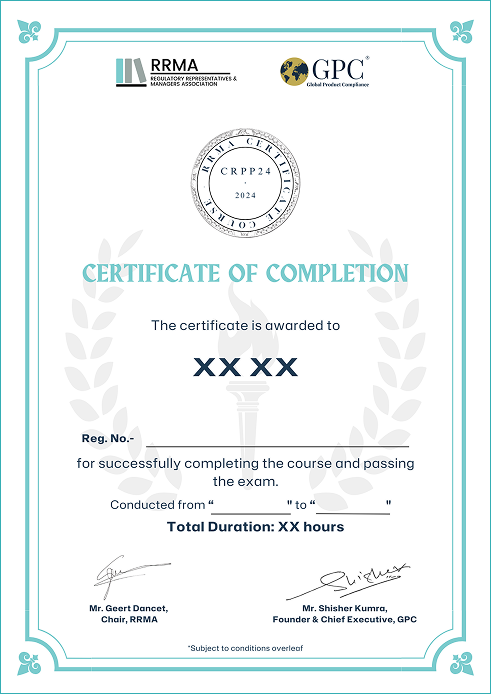
What They Say
.jpg)
Prachita Mhatre
+ Yrs. of Professional Experience
" Thank you RRMA for offering the helpful certification program. The course is very well structured. This program is a worthwhile investment for anyone looking to advance their career in product safety, quality, product management and regulatory fields."
.jpg)
Manik Sawant
15+ Yrs. of Professional Experience
" I want to take this opportunity to thanks all the faculty members for the support and coordination throughout the program. It provided context and deep learning for my role as regulatory professional. I will surely be recommending it to advance a career in chemical compliance."
.jpg)
Marina Lebedeva
12+ Yrs. of Professional Experience
" The program provided a general structure and model for technical regulation that helps to systematize my knowledge, it gave me valuable insights into chemical regulation in India and other countries. All this is very helpful in my work and will definitely contribute to my career."
.jpg)
Danielle McCarthy
5+ Yrs. of Professional Experience
" Comments on how the program has contributed to your career. The program has contributed to my career by expanding my knowledge and abilities in compliance, policy interpretation, risk management and global regulatory affairs."
.jpg)
Mayur Malkan
15+ Yrs. of Professional Experience
" This program covered comprehensive understanding of compliance requirements, good practices on handling chemical products, Regulatory assessment. Had a very good insights on Technical regulations for India & global regions which enhanced my skills further on decoding the regulations."
.jpg)
Nitin Shingare
10+ Yrs. of Professional Experience
" I highly recommend the Certified Regulatory Professionals Program (CRPP) to anyone looking to advance their career in the regulatory field. The program's comprehensive approach and expert instruction have had a profound impact on my professional development."
.png)
Mr Sergio
5+ Yrs Professional Experience
" The Certified Regulatory Professionals Program (CRPP)- Chemical products is a unique initiative by RRMA and GPC, providing a comprehensive understanding of international and regional regulations, allowing technical professionals to align their knowledge with the frontline of the field . Recommend to professionals like me."
.png)
Aleksei Polosukhin
20+ Yrs. of Professional Experience
" Global regulatory trends and regulatory trends on India market regarding chemicals are important. And the RRMA course highlights the key points. It allows me to extend my expertise and look forward more confidently"
.jpg)
Ilia Efros
15+ Yrs. of Professional Experience
" As a result of the program, we reorganized the approaches to organizing chemical management in the company."

Marcella Medeiros
10+ Yrs. of Professional Experience
" Completing the CRPP has elevated my professional profile and equipped me with the tools to ensure my projects meet crucial compliance standards. As a result, I feel more prepared to advise my team and stakeholders on regulatory matters, thereby advancing both my career and the overall success of our initiatives."

Liliia Baiazitova
15+ Yrs. of Professional Experience
" I already use the information I received in my professional activities. Thanks to the speakers of the RRMA Academy for the useful knowledge!"

Dan Blumberg
5+ Yrs Professional Experience
" The majority of subjects were adequate for EU-oriented company BIS basics, and the instructors were knowledgeable and well-prepared for the presentations."
Video testimonials
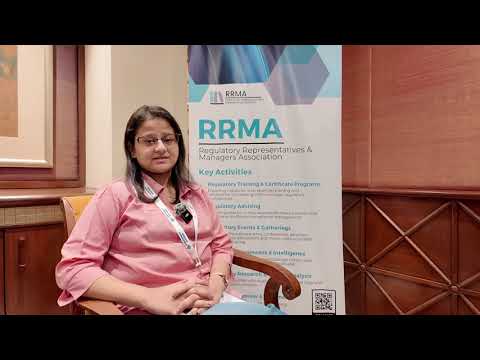
Isha Bhargava
Godrej Industries Ltd (Chemical Division)

Shubham Nirale
Godrej Industries Ltd (Chemical Division)
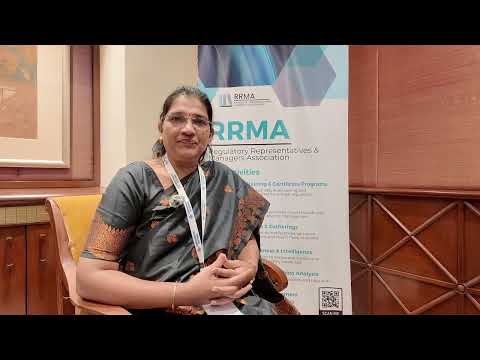
Rupali Hande
Nichem Solutions
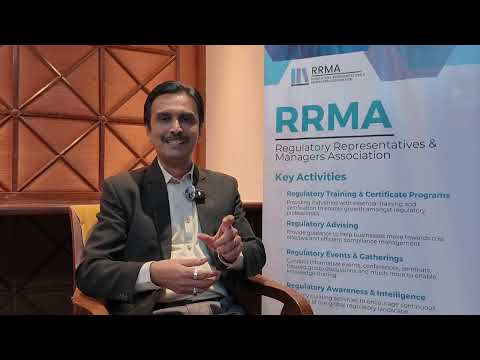
Karthik Nilagiri
Reliance Industries Limited
Mayur Malkan
Arxada ARCH PROTECTION CHEMICALS PVT LTD
Chaitali More
Auxilife Scientific Services
Arti Khune
Compliance Director
ChemTech Industries
Frequently Asked Questions
Ready to Advance Your Career?
Join 100+ professionals who have earned their certification and transformed their careers in chemical regulatory affairs. Start your journey today and become a certified regulatory professional.
Enroll Now
Questions About This Program?
Our enrollment advisors are here to help you make the right decision for your career